
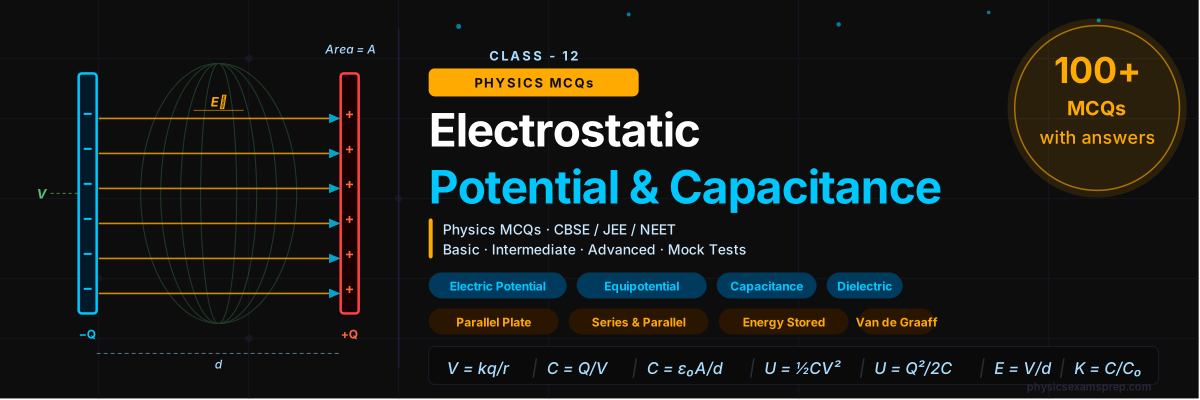
Class 12 Electrostatic Potential and Capacitance MCQs with Answers
Prepare Class 12 Electrostatic Potential and Capacitance MCQs on electric potential and energy storage.
Includes Mock Test with Instant Performance Report for CBSE, JEE & NEET Exams.
Quick Revision: Electrostatic Potential and Capacitance
- Electrostatic Potential (V): Work done per unit charge in bringing a positive test charge from infinity to a point. V = (1/4πε₀) × (q/r)
- Potential Difference: VB - VA = -∫AB E·dl
- Relation between E and V: E = -dV/dr (in 1D), E = -∇V (in 3D)
- Equipotential Surfaces: Surfaces where potential is constant. Electric field lines are perpendicular to equipotential surfaces.
- Capacitance (C): C = Q/V. SI unit: Farad (F).
- Parallel Plate Capacitor (Air/Vacuum): C = ε₀A/d
- With Dielectric: C = K C₀ = Kε₀A/d, where K is dielectric constant.
- Energy Stored in Capacitor: U = ½CV² = ½QV = Q²/2C
- Energy Density: u = ½ε₀E²
- Series Combination: 1/Ceq = 1/C₁ + 1/C₂ + ... Charge same on each.
- Parallel Combination: Ceq = C₁ + C₂ + ... Voltage same across each.
- Spherical Capacitor: C = 4πε₀ × (ab)/(b-a)
- Cylindrical Capacitor: C = 2πε₀L / ln(b/a)
- Dielectric Strength: Maximum electric field a dielectric can withstand without breakdown.
External Resources: Hyperphysics - Capacitance | Khan Academy - Capacitors
Chapter Summary: Electrostatic Potential and Capacitance
Electrostatic Potential and Capacitance MCQ Class 12 extends the concepts from electric fields to potential energy and storage of electric charge. The chapter introduces electrostatic potential as a scalar quantity that represents the work done per unit charge, providing an alternative perspective to electric fields for analyzing electrostatic systems.
Key topics include the calculation of potential due to various charge distributions, the relationship between electric field and potential through gradient operations, and the concept of equipotential surfaces. The behavior of conductors and the principle of electrostatic shielding are explained through potential concepts. The chapter then transitions to capacitance, defining it as the ability of a conductor to store charge per unit potential.
Various capacitor configurations - parallel plate, spherical, and cylindrical - are analyzed with their respective capacitance formulas. Circuit applications cover series and parallel combinations of capacitors and the energy storage capabilities of these devices. The chapter concludes with the study of dielectrics, their polarization effects, and how they enhance capacitance while reducing the effective electric field within capacitors.
This chapter bridges the gap between fundamental electrostatics and practical electrical components, laying the groundwork for understanding more complex circuits and electromagnetic systems.
Practice more: Try our Chapter 3: Current Electricity MCQs.
Loading questions...